
For a lot of first-timers, IFS turns out to be a gentle way in, because it runs on curiosity, and curiosity doesn't need the right words. For some people, something else should come first. Knowing who IFS therapy is for, and who it may not suit, tells you which group you're in.
TL;DR Quick Answers
Who Is IFS Therapy For? (And Who It May Not Suit)
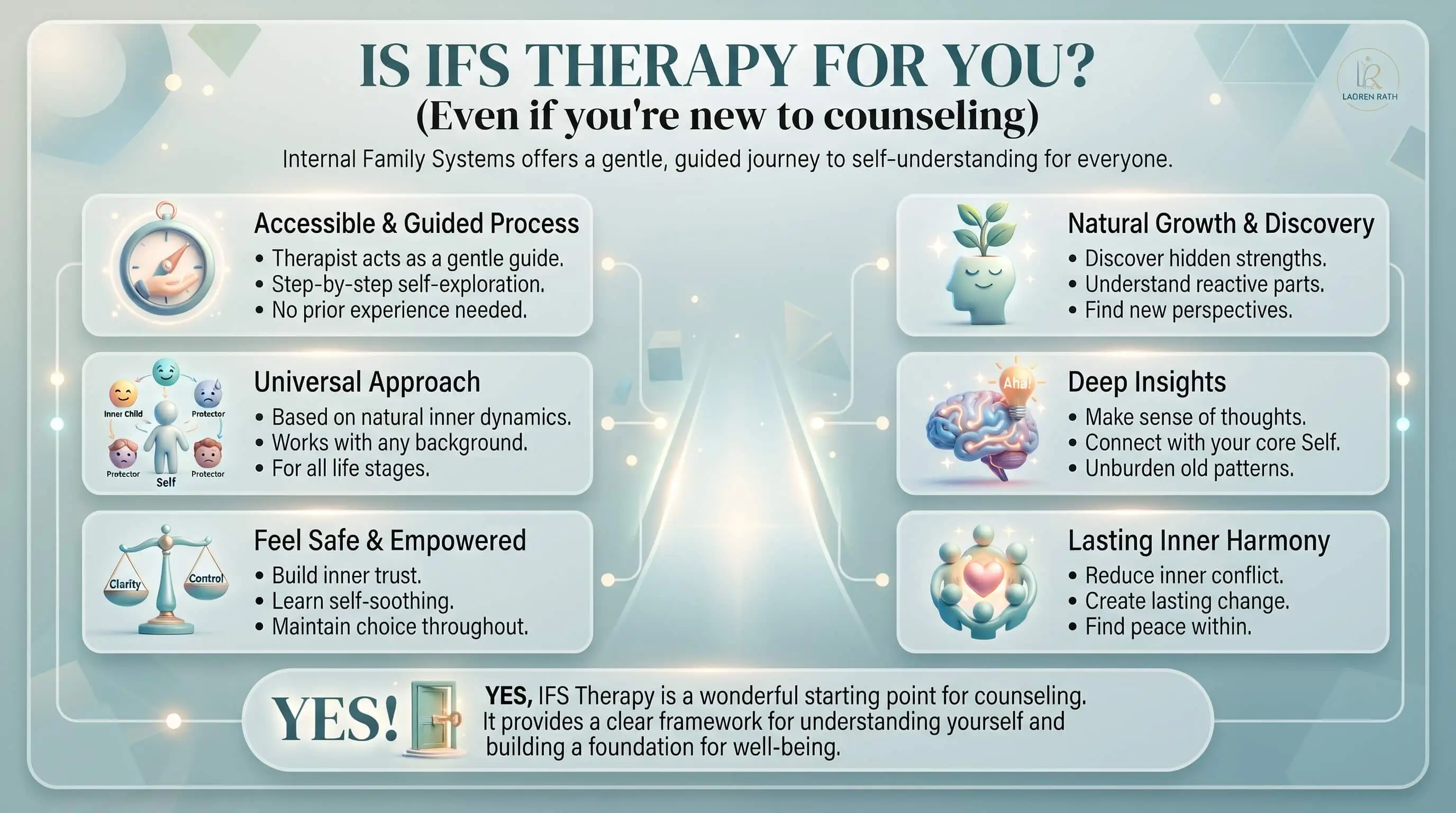
IFS therapy is for adults who already understand their patterns but can't seem to change them, including people who have never tried counseling. It works through curiosity, not therapy experience, so you don't need the right words to start.
Often a good fit:
People pulled two ways by strong, conflicting feelings
People with a harsh inner critic or perfectionism
People whose childhood still shapes how they react today
People stuck in the same relationship patterns
People who've tried talk therapy and felt nothing move
May not suit, at least not first:
Anyone in crisis or unsure about their safety (call or text 988)
People experiencing psychosis or severe dissociation
People in active substance use
People who want worksheets, skills, and homework (CBT or DBT may fit better)
People who need large-scale evidence before committing
Bottom line: Fit and failure are different things. A good IFS therapist will tell you if it isn't right for you and point you to who is.
Top Takeaways
IFS can be a gentle first therapy because it relies on curiosity rather than on having the right words.
It tends to suit people stuck in inner conflict, harsh self-criticism, or old patterns they already understand.
People in crisis, with psychosis or severe dissociation, or in active substance use usually need a different starting point.
If you want worksheets and structured skills, CBT or DBT may fit better.
IFS research is promising but still small, so be wary of promised outcomes.
Shakiness and a racing heart deserve a medical check before you assume anxiety.
When Your Body and Your Worries Feel Tangled Up
A shaky hand at 3 p.m. A heart that won't settle. A short fuse you can't explain. The National Institute of Diabetes and Digestive and Kidney Diseases lists shakiness, dizziness, irritability, and a fast or uneven heartbeat among the signs of low blood sugar. From the inside, that's also what anxiety can feel like.
So start with your body. If these symptoms keep showing up, see your doctor and get the physical causes checked. Low blood sugar has treatable causes, and it deserves a proper workup.
If the tests come back fine and the worry hasn't gone anywhere, that tells you something too. It may be time to talk with someone about what's going on underneath, and that's often where people first hear about IFS.
What IFS Therapy Is, in Plain Language
Internal Family Systems (IFS) therapy starts with a simple idea. Your mind isn't one voice. It works more like a group, where one part of you wants to rest and another insists you haven't earned it, or one part wants closeness while another keeps everyone at arm's length.
IFS calls these parts. Underneath them is what IFS calls Self, a steadier, calmer you that can notice your parts without being run by them.
Some parts try to keep you safe ahead of time by planning and criticizing, and they like to stay in control. IFS calls them managers. Others rush in when pain breaks through, numbing it or blowing up, and those are firefighters. Then there are the parts still carrying old hurt, which IFS calls exiles.
You don't need to memorize any of this. Think of it as a rough map you can set aside whenever it stops being useful. You also don't have to believe you literally have parts. Most people find it's just a kinder way of listening to themselves.
What Your First IFS Session Usually Looks Like
First sessions are quieter than most people expect. You won't be asked to dig into your deepest pain on day one.
Mostly, we cover the basics: what brought you in, what's been hard lately, and what you'd like to feel different. I'll explain how I work and ask what you need to feel comfortable.
Later, the work gets more experiential. Say you notice your chest tighten when you talk about your job. I might ask you to stay with that feeling for a moment and get curious about it. What's it worried about? What's it trying to do for you?
There aren't right answers, and you don't have to perform. We go slowly, and you set the pace. A lot of people do this work by video from their own couch, which takes some of the edge off trying counseling for the first time.
Who Is IFS Therapy For? (And Who It May Not Suit)
IFS tends to help most when you already understand your patterns and still can't change them. That gap between knowing and changing is where parts work earns its keep. I've written a longer guide on who IFS therapy is for (and who it may not suit), and here's the short version.
Signs IFS May Be a Good First Step
You often feel pulled two ways about the same thing.
A harsh inner critic or perfectionism runs most of your day.
Your childhood still shapes how you react, even if nothing "big enough" happened.
You know why you do what you do, but knowing hasn't changed it.
You keep landing in the same relationship patterns.
You'd rather notice or feel things than analyze them out loud.
None of these require therapy experience. People who haven't learned to "do therapy" sometimes arrive with less to unlearn.
When Another Starting Point May Help
You're in crisis or unsure about your safety. Immediate support comes first. Call or text 988 any time, day or night.
You're experiencing psychosis or severe dissociation. Stabilization usually needs to come before parts work, and a clinician can help you sort out the order.
You're in active substance use. Other approaches tend to be a better first step.
You want worksheets, skills, and homework. CBT or DBT may suit you better.
You need large-scale evidence before committing. That's a fair standard, and IFS research isn't there yet.
Your main worry is someone else's behavior. Individual work has limits when the problem centers on a parent or partner.
If IFS isn't the right fit, a good therapist will say so and point you toward someone who is. Fit and failure are different things.
How IFS Compares With Talk Therapy and CBT for Beginners
IFS
Main focus: How your inner parts relate to each other
How sessions feel: Slow, experiential, and turned inward
Homework: Little or none
Often a fit for: Inner conflict, self-criticism, and old wounds
Traditional talk therapy
Main focus: Your story, feelings, and patterns
How sessions feel: Conversational
Homework: Depends on the therapist
Often a fit for: Working through life events and relationships
CBT
Main focus: Thoughts, beliefs, and behaviors
How sessions feel: Structured and goal-directed
Homework: Usually
Often a fit for: Specific symptoms you want practical skills for
Plenty of therapists blend approaches. Some pair IFS with EMDR, which targets specific memories while IFS works with the wider system of parts guarding them. You don't have to pick the right method alone. Sorting that out is what a consultation is for.
What the Research Says So Far
IFS research is real, and it's young. The IFS Institute keeps a running list of published studies on its research page, including small randomized trials and pilot studies on depression, PTSD, and rheumatoid arthritis.
The results look promising, especially for depression and self-compassion. Most of the studies are small, though, and the field still needs larger trials. Some clinicians also worry that IFS is spreading faster than the training behind it, which is a good reason to work with a licensed, properly trained therapist instead of a social media version of parts work.
Anyone promising you a cure or a timeline is selling something.
"People often tell me in our first session that they don't know how to do therapy. I tell them that's fine, because IFS doesn't ask you to perform. It asks you to notice. The self-critical voice most people walk in with isn't the enemy, and arguing with it rarely helps. Getting curious about its job usually does. What I see again and again with people new to counseling is that curiosity comes faster once they stop trying to get therapy 'right.' And if IFS isn't the right fit for someone, I'll tell them and help them find what is."
7 Essential Resources
IFS Institute: Research. Published IFS studies and what they found, from the organization that trains IFS therapists.
NIMH: Psychotherapies. A plain overview of common therapy types, with questions worth asking before you pick a therapist.
American Psychological Association: Understanding Psychotherapy and How It Works. What therapy is like, how long it tends to last, and how confidentiality works.
988 Suicide & Crisis Lifeline. Free, confidential support by call, text, or chat, around the clock.
NIDDK: Low Blood Glucose (Hypoglycemia). Low blood sugar symptoms, worth reading before you assume it's anxiety.
Society for the Advancement of Psychotherapy: IFS and Its Problematic Popularity. A critical look at who may not benefit from IFS and why training matters.
NIMH: Mental Illness Statistics. National numbers on how many adults struggle and how many get care.
These resources offer guidance on IFS therapy, mental health treatment, therapist qualifications, and crisis support. They also highlight the importance of recognizing physical conditions like Hypoglycemia, which can cause symptoms similar to anxiety, when exploring emotional well-being and appropriate mental health care.
3 Statistics
You're Far From the Only One
About 59.3 million U.S. adults lived with a mental illness in 2022. That's 23.1% of adults, or more than one in five. Needing support is common.
Source: National Institute of Mental Health
Roughly Half Never Get Care
Only 50.6% of adults with a mental illness received mental health treatment in 2022. If you're reading this and thinking about counseling for the first time, you're further along than you might feel.
Source: National Institute of Mental Health
Young Adults Are the Least Likely to Start
Among adults with a mental illness, 18- to 25-year-olds had the lowest treatment rate of any age group in 2022, at 49.1%.
Source: National Institute of Mental Health
Final Thoughts and Opinion
I don't think being new to counseling is a barrier to IFS. Sometimes it helps. You haven't spent years explaining your feelings away, and in this work, curiosity counts for more than experience.
I also don't think IFS should be sold as the answer for everyone. If you're in crisis, want structure, or need a big evidence base first, starting somewhere else is a smart call.
And if what you're feeling is mostly physical, the shakiness and the racing heart, see your doctor before anything else. Your body deserves to be taken seriously too.
When you're ready, find someone you don't have to perform for. You can walk in without having any of it figured out.
Frequently Asked Questions
Is IFS therapy okay if I've never been to therapy before?
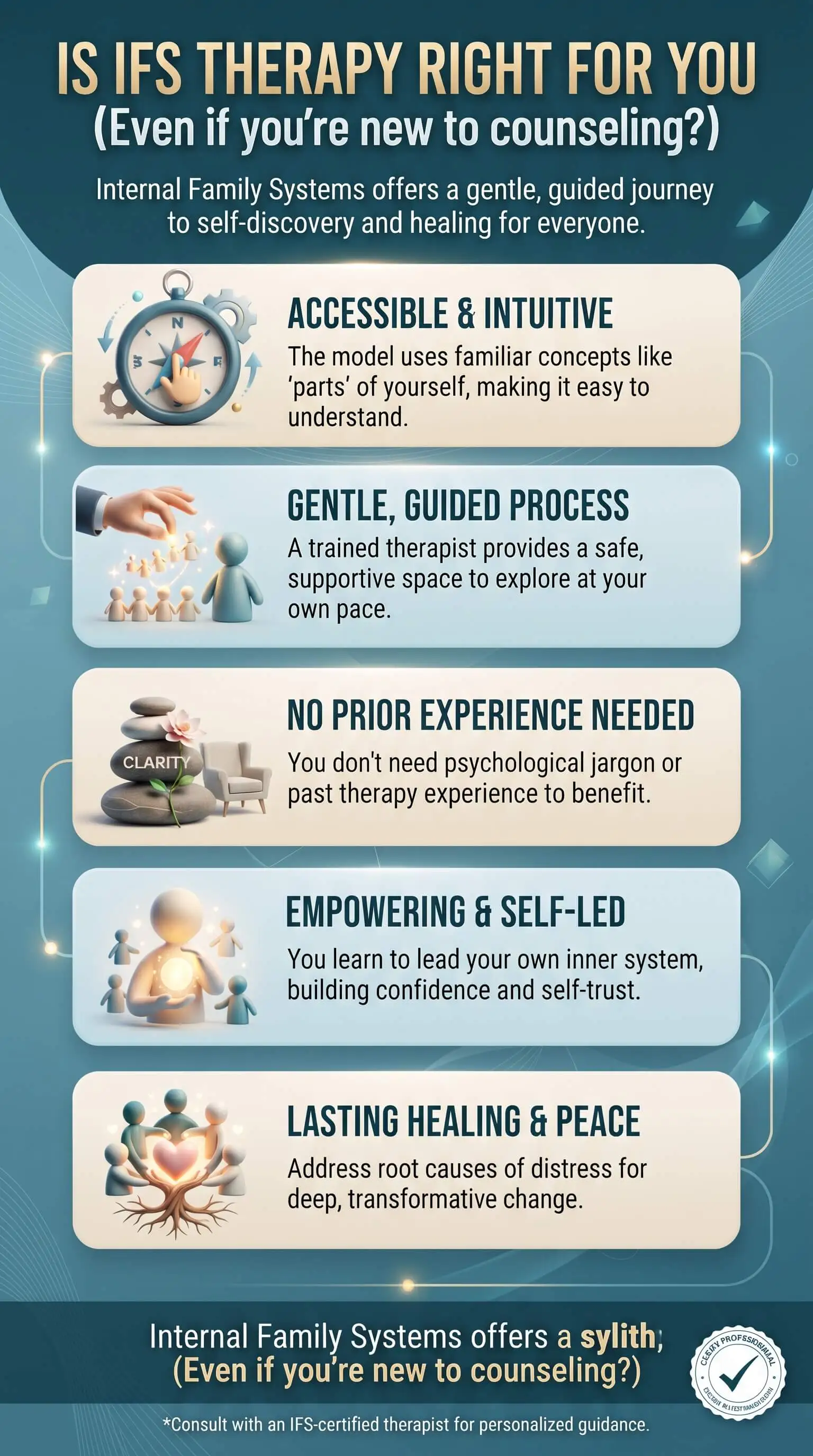
For many people, yes. IFS doesn't require therapy vocabulary or a tidy story. It asks you to notice what you feel and get curious about it. Your therapist guides the pace, and early sessions are about getting to know you, so nobody expects you to go deep right away.
Who is IFS therapy not recommended for?
IFS usually isn't the best starting point if you're in an acute crisis, experiencing psychosis or severe dissociation, or in active substance use. It may also be a poor match if you want structured homework or need extensive evidence before you begin. A trained therapist can help you judge fit.
Do I have to believe I have "parts" for IFS to work?
No. "Parts" is shorthand for the feelings and urges you already notice, like the part that wants to rest and the part that won't let you. Treat it as a metaphor if that's easier. Most people find it just makes looking inward feel kinder.
What happens in a first IFS therapy session?
You'll talk about what brought you in, what's been hard, and what you'd like to change. Your therapist explains how IFS works and answers your questions. Deeper parts work comes later, at a pace you choose. All you need to bring is honesty.
Is IFS therapy evidence-based?
The research base is growing but limited. Small randomized trials and pilot studies show promising results, especially for depression and self-compassion, and the IFS Institute tracks what's been published. The field still needs larger trials, so be cautious of guaranteed results.
Can I do IFS therapy online?
Yes. Many IFS therapists see people over secure video, and the inward, reflective style of the work holds up well on a screen. Being at home can make a first try at therapy feel easier. If you're considering online IFS therapy in Washington, just check that your therapist is licensed in the state where you live.
Could my anxiety symptoms actually be low blood sugar?
They could be. Low blood sugar can cause shakiness, dizziness, irritability, and a fast or uneven heartbeat, which overlap with anxiety. Ask your doctor to rule out physical causes first. If those come back clear and the worry continues, counseling is a reasonable next step.
Curious Whether IFS Fits You?
You don't have to decide alone, and you don't have to decide today. If you live in Washington State, I offer a free 15-minute video consultation to talk through what's going on, with IFS therapy explained in a way that helps you decide whether it makes sense for you. No pressure either way, and "not right now" is a perfectly good answer.
Outside Washington, look for a licensed therapist with formal IFS training near you. And if you're struggling right now, call or text 988 for immediate support.